
The Woman in the Frame Is Carrying More Than You Think
Aug 04, 2026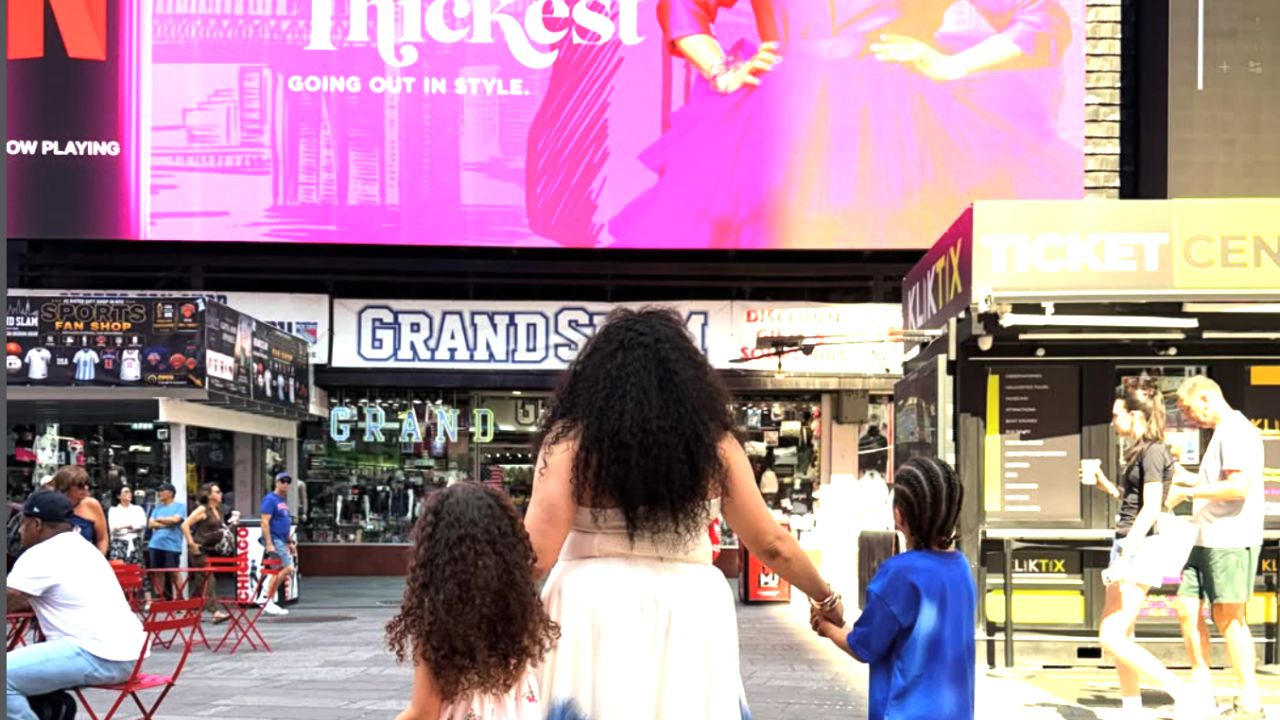
Everyday feminism lives in the space between being responsible for everyone and still insisting on being seen. One of the Netflix shows Leslie keeps coming back to is Survival of the Thickest, created by and starring Michelle Buteau, the funny, luminous, multi-hyphenate actress, comedian, writer, producer, director, and podcast host. Her work feels real because it centers underrepresented voices and identities without turning them into lessons. I follow her on Instagram, and this image stopped me because it held so much of what I recognize: the daily juggling act of being an artist hyphenated with caregiver, visible and responsible, inspired and interrupted, still trying to move through the world as a whole person. There is a particular kind of woman who can hold a child’s hand, scan the street for danger, remember the snacks, manage the schedule, answer the text, carry the emotional weather of the entire household, and still look like she belongs on a billboard. Not because she is trying to be perfect. Because she has not agreed to disappear. That matters. So much of culture still asks women, especially mothers and caregivers, to become background. Be useful, but not loud. Be beautiful, but not too aware of it. Be ambitious, but not at anyone’s inconvenience. Be nurturing, but don’t expect applause. Be everything, but make it look like nothing. Everyday feminism starts where that bargain breaks. It starts in the crosswalk. In the grocery aisle. In the school pickup line. In the subway reflection. In the moment a woman remembers she is not only the person making sure everyone else gets there safely. She is also going somewhere. Seeing the woman who helps everyone else be seen Care work is often treated like air. Everyone needs it. Everyone benefits from it. Almost no one notices it until it is gone. The lunches packed. The appointments booked. The costumes found. The birthdays remembered. The moods regulated. The tiny hands held. The older parents called. The friend checked on. The partner encouraged. The house made livable. The room made softer. The world made less sharp. This is labor. Not a personality trait. Not a feminine instinct. Not a cute little bonus feature that comes pre-installed with womanhood. Labor. And still, the women doing it are expected to remain grateful, graceful, and preferably quiet. But the woman in public with children beside her is not a symbol of limitation. She is a whole person moving through the world with witnesses. She is caretaker and decision-maker. Soft place and strategist. Snack holder and cultural force. She is not evidence that her life got smaller. She is proof that her life contains multitudes. The artist does not vanish when the caregiver enters One of the great lies sold to women is that creativity belongs to the uninterrupted. As if art only happens in quiet rooms, clean desks, and long stretches of time no one needs anything from you. Please. Some of the most creative women alive are making work between school forms and voice notes. They are writing after bedtime. Recording in parked cars. Sketching at the kitchen table. Building businesses with one tab open for invoices and another for pediatric dosing charts. Is it romantic? Not always. Is it glamorous? Occasionally, if the lighting is merciful and nobody has spilled juice. Is it art? Absolutely. Caregiving can interrupt creative identity, but it does not erase it. The artist may move differently. She may work in fragments. She may have to fight harder for time, space, and the right to take herself seriously. But she is still an artist. A woman does not become less creative because she is responsible for other people. Sometimes, she becomes more precise. More urgent. More allergic to nonsense. More aware that time is not theoretical. Her work carries the pulse of real life because real life keeps walking into the room asking for socks. “She is not disappearing into care. She is arriving through it, louder, softer, funnier, fuller, and entirely her own.” Public joy is political There is something radical about a woman enjoying herself in public. Not performing happiness to make everyone comfortable. Not smiling on command. Not shrinking her body, her laugh, her outfit, her hunger, her opinion, or her ambition. Actual joy. The kind that takes up sidewalk space. The kind that says, yes, I have responsibilities, and yes, I still get to feel good in my body. I still get to be stylish. I still get to be desired. I still get to be ridiculous. I still get to be seen in color. Feminism is not only protest signs and policy briefs, though we need those too. It is also a woman refusing to treat her own pleasure as extra credit. It is the lipstick before the errand. The joke in the middle of exhaustion. The dress that makes no practical sense and yet solves something spiritual. The photo taken because she looked good and knew it. The decision to stop waiting until the work is done before she is allowed to exist beautifully. Public joy says: I am not only surviving the demands placed on me. I am still here. I am still mine. Everyday feminism has better lighting than we admit Academic feminism gives us language. It helps us name systems, labor, power, and erasure. We need that language. But feminism also happens outside the classroom, where the theory has to wear shoes and find parking. It happens when a mother corrects someone who calls parenting “helping” when a father does it. It happens when a daughter sees her mother rest without apologizing. It happens when a caregiver asks for money, credit, time, and support instead of accepting praise as payment. It happens when women stop calling their dreams “little.” It happens when friends tell the truth about how hard it is, then laugh so loudly the table next to them gets invested. This is not feminism watered down. This is feminism with a purse full of receipts, lip balm, crayons, invoices, and emergency almonds. It is lived. It is funny. It is tired. It is brilliant. It is wearing comfortable shoes, unless it is not, in which case please respect the commitment. The billboard and the sidewalk Visibility is complicated. Some women are made hypervisible in ways that flatten them. Some are ignored until they are useful. Some are celebrated only when they fit a narrow story. Some are praised for strength because nobody wants to offer support. So being seen is not automatically liberation. The question is: seen as what? As a full person, or a role? As a body, or a voice? As a caregiver, or a creator too? As someone who serves the story, or someone who authors it? The billboard version of womanhood is often polished, enlarged, and edited. The sidewalk version is where the truth lives. The woman moving through the city with children beside her may not be posing, but she is still composing a life. She is teaching them how to cross the street. She is teaching them what presence looks like. She is teaching them that care and selfhood can stand in the same frame. Closing reflection The other F word here might be feminism. It might also be fullness. Because that is what so many women are fighting for. Not a perfect balance. Not a sanitized empowerment slogan. Not the fantasy of having it all with great skin and no childcare gaps. Fullness. The right to be tender and ambitious. Needed and needy. Stylish and exhausted. Maternal and sensual. Serious and hilarious. Private and public. A person who carries others without becoming invisible under the weight. Everyday feminism asks us to look again at the women walking in front of us, beside us, and inside our own mirrors. Not as background. Not as support staff for everyone else’s becoming. As the main characters of their own complicated, gorgeous, unfinished lives. Reflection prompt: Where in your life have you been treated as the caretaker of the story instead of the author of it? And what would it look like to let yourself be seen as both?
CTA: Join the conversation.
Image Source: @Michelebuteau
with care, curiosity, and a little side-eye,
Leslie + Katy
WTF: The Other F Word is a warm, artist-led space for curious creatives ready to trust themselves, honor their boundaries, and build a practice that feels honest, sustainable, and fully their own.
Stay in the loop
Get new episodes, notes, and artist-led reflections from WTF: The Other F Word. Thoughtful updates for creatives exploring self-trust, care, and feminist practice.
Occasional emails only. No spam, no gatekeeping, and you can unsubscribe anytime.